GTM Strategy
Every Job Posting Tells You Where a Company Is Going: Reading Hiring Signals Like a GTM Pro
Every job posting reveals a company's biggest problems and its next budget decisions. Here is how to read hiring signals like a GTM pro and lift response rates by 340%.

Rahul Dev
Founder & CEO at Harvin
How to Read a Job Posting Pattern
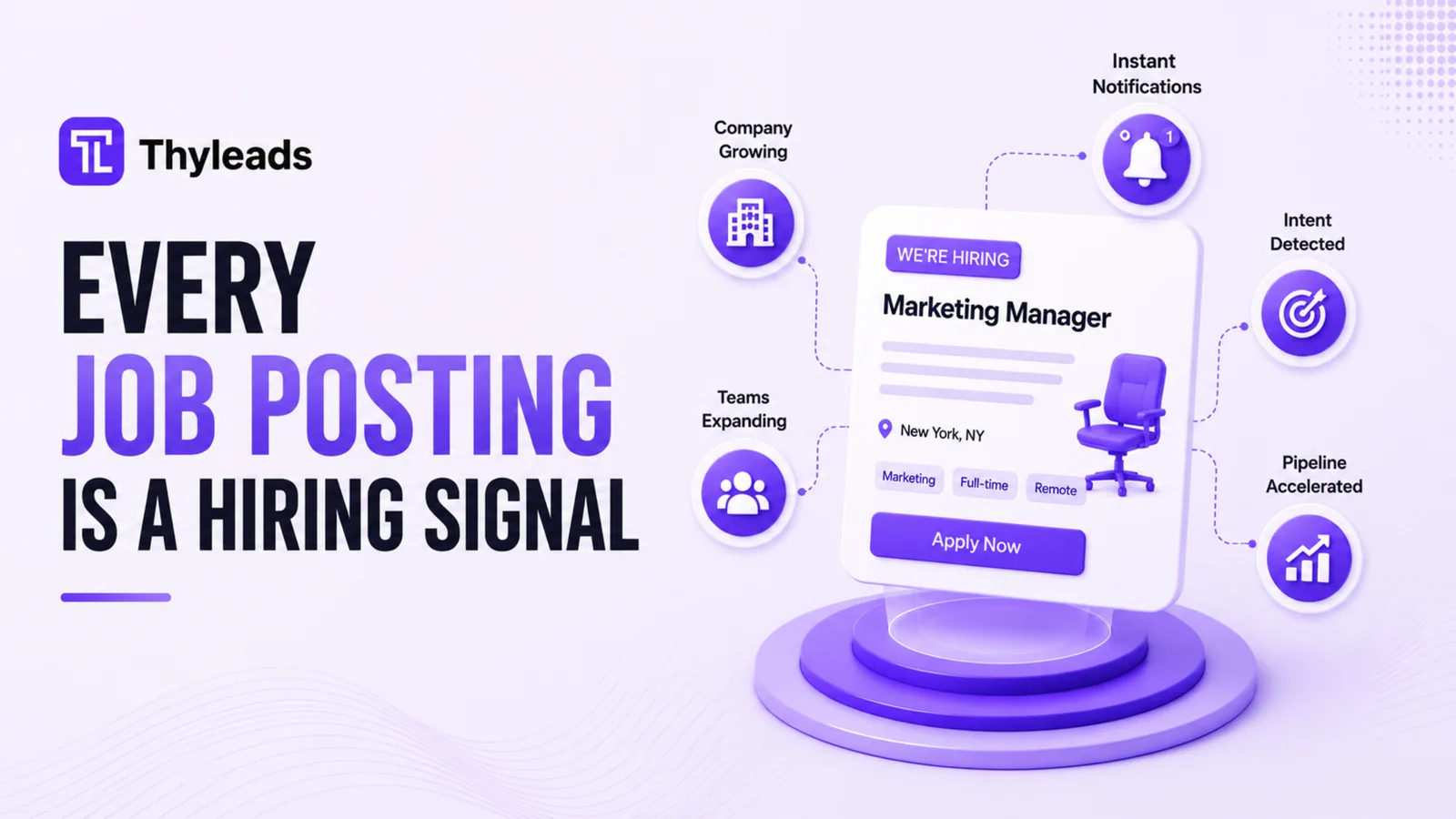
Most reps chase the same two things: the 'We're hiring!' post and the funding announcement everyone already saw on their feed. The teams that consistently book meetings look at something quieter. A job posting is one of the most honest documents a company will ever publish, because it tells you exactly what is broken and where the money is about to go.
We spent three years watching how SaaS companies hire before it became a real part of how we work at Harvin. The pattern below is the same one our clients used to lift response rates by 340% and pull roughly 47 days out of their average sales cycle.
The problem with traditional prospecting
You know how it goes. A company posts a role, and within a few hours the hiring manager's inbox fills up with the same message dressed in slightly different words: 'Congrats on the growth, we'd love to support you.' The timing is right. The message is empty.
Everyone reads the headline. Almost nobody reads the story.
A new role is never just a request for another person. Read it closely and it tells you four things at once:
- What is quietly breaking inside the company right now
- Which projects have already cleared budget
- Where leadership is actually feeling the pressure
- What they need fixed in the next quarter
When you reach out with that context, you stop sounding like a vendor and start sounding like someone who has been in the room. That shift is what moves your reply rate, not a better subject line.
The six hiring signals worth watching
- 1. Revenue Operations or Sales Enablement Hires
- 2. Customer Success or Implementation Specialists
- 3. Integration Engineers or API Developers
- 4. Growth or Lifecycle Marketing Roles
- 5. Regional Heads or Country Managers
- 6. Security Analysts or Compliance Heads
Revenue Operations or Sales Enablement Hires
What it really means: The pipeline is outrunning the plumbing. Deals are coming in faster than anyone can clean up after them, so the data is messy, leads fall through the gaps, and the CRM has quietly become a place where good intentions go to die.
Your timing window: Roughly 30 to 60 days after the role goes live. By then the new hire has seen the full mess they walked into and has started writing down every tool they wish they had.
What to pitch: Lead enrichment, CRM automation, sales onboarding, or anything that stitches the data back together.
Opening line that works: 'Saw you're building out Rev Ops. Braced for the data cleanup that usually comes with it?' It works because you are not congratulating them on growth. They already know they are growing. You are the one who understands the operational headache that shows up right behind it.
Customer Success or Implementation Specialists
What it really means: The sales motion is finally landing, and the worry has moved down the funnel. The conversation inside the company has shifted from 'how do we close more' to 'how do we keep the ones we just won.'
Your timing window: The first week or two after the new hire starts. They still have fresh eyes and have not yet disappeared into a queue of escalations.
What to pitch: Onboarding and activation tools, churn prediction, or anything that takes repetitive CS work off their plate.
Opening line that works: 'Your new CS hire is going to thank you for fixing churn before it lands on their desk.'
Integration Engineers or API Developers
What it really means: The stack has sprawled and the temporary fixes are giving out. Someone on the team is losing whole afternoons to manual data pushes and brittle integrations that snap every time a vendor ships an API change.
Your timing window: While they are still hiring. That is when the pain is loudest and someone in the room is quietly adding up what it really costs to build all of this in-house.
What to pitch: Data orchestration, embedded integrations, or developer tooling that saves the team from reinventing the same connectors.
Opening line that works: 'Building your integrations in-house? Here's the part your new engineer will wish someone had flagged first.'
Growth or Lifecycle Marketing Roles
What it really means: They are done with spray-and-pray. The team wants to know which channels actually pay off, how to keep customers engaged past the first month, and where retention is leaking.
Your timing window: The first 90 days, while the new hire is drafting a strategy and quietly deciding which tools they cannot live without.
What to pitch: Attribution, personalization, journey mapping, or retention analytics.
Opening line that works: 'Your new growth lead is about to ask for a tool you've never heard of. Want to be the one who already has it?'
Regional Heads or Country Managers
What it really means: They are moving into a new market, and everything that comes with it is about to land on someone's desk at once: local compliance, tax rules, hiring, and a dozen things nobody accounted for.
Your timing window: Two to three months before the launch, while the plan is still being written and the budget lines are still soft.
What to pitch: Localized GTM tooling, international compliance, global hiring, or multi-currency billing.
Opening line that works: 'Expanding into [region]? A few compliance landmines tend to surface right around this stage. Happy to share what usually catches teams off guard.'
Security Analysts or Compliance Heads
What it really means: Something set off a risk review. It could be a near miss, an audit on the calendar, or simply the point where the company got big enough that security stopped being optional and became a board topic.
Your timing window: Right away. Once security jumps up the priority list, budgets get approved faster than almost anything else.
What to pitch: Audit trails, contract management, identity management, or compliance tooling.
Opening line that works: 'Curious what pushed security up the list this quarter. Whatever it was, there's usually a second wave right behind it worth getting ahead of.'
The quieter signals most people walk past
Once the six above become second nature, a few subtler patterns are worth watching for.
A burst of similar roles rarely means calm, planned growth. Three 'Software Engineer' posts in two weeks usually means something is on fire and they are hiring their way out of it.
A senior and a junior version of the same role posted together tells you they are standing up a function from scratch. That is your opening to bring a full solution to the table instead of a single feature.
The same role reappearing within six months almost always means the first hire did not stick. Nine times out of ten, the tools and processes were broken, not the person, and that is a conversation worth having.
A wave of remote-first roles tells you the distributed-team headaches are on their way: slower communication, thinner security, messier onboarding, and compliance to untangle across more than one jurisdiction.
How to scale this without burning out
Reading every posting by hand works right up until you have more than a handful of accounts. Here is how we let the software do the watching.
Clay and Apollo: Set up workflows that keep an eye on hiring at your target accounts and ping you the moment a relevant role goes live.
Phantom Buster: Pull postings by keyword and company so you build a running record of who is hiring for what.
6sense or Bombora: Put intent data next to the hiring signal so you can confirm someone is actually in-market before you write a word.
Outreach or Salesloft: Wire up sequences that kick off on their own when a specific role or job change hits an account you care about.
Zapier: Pipe job boards straight into your CRM and outreach stack so none of this needs a human babysitting it.
From signal to sale
This is the sequence we run at Harvin to turn a job posting into pipeline.
Level 1: Watch the postings at your target accounts.
Level 2: Read each posting as a business priority, not a job title.
Level 3: Time the outreach to their decision cycle, not yours.
Level 4: Write to the specific problem the hire is meant to solve.
Level 5: Follow up as their situation actually plays out.
The step almost everyone skips is patience. Do not fire off a message the day a role appears. Ask yourself where that hire puts the company in three months, then show up when they are ready to hear from you.
Why it lands
Old-school outbound starts with what you are trying to sell. Signal-based outreach starts with what they are already trying to buy.
Message someone the week after they hire a Rev Ops lead and you are not interrupting anything. You are showing up at the exact moment the problem you solve is on their mind.
It also quietly changes who you are in the conversation. You stop being the eleventh vendor of the week and become the person who understood the business well enough to see the next headache coming.
Where to start
You do not need to boil the ocean. Start here.
- Pick 50 target accounts and turn on job posting alerts
- Choose two signals to run first (Rev Ops and CS are the easiest to spot)
- Write real messaging for each one, not a template with the role swapped in
- Watch your reply rates and adjust based on what actually gets answered
- Add more signals and automation once the first two are working
It comes down to one shift in thinking. Good outbound is not about who is hiring. It is about why they are hiring.
The teams that get that difference are the ones that will keep winning in B2B, this year and the next.
Want to build your outreach around this? Harvin runs signal-based prospecting at scale for B2B SaaS companies.
Contact us and we'll show you how a job posting turns into qualified pipeline. If you are working out how to run a team around signals like these, start with what an SDR management platform is.
About Harvin
Harvin is a B2B lead generation company that helps SaaS companies find and convert high-intent prospects using signal intelligence and AI-powered automation. Our clients typically see 3x higher response rates and 40% shorter sales cycles within 90 days of getting started.